
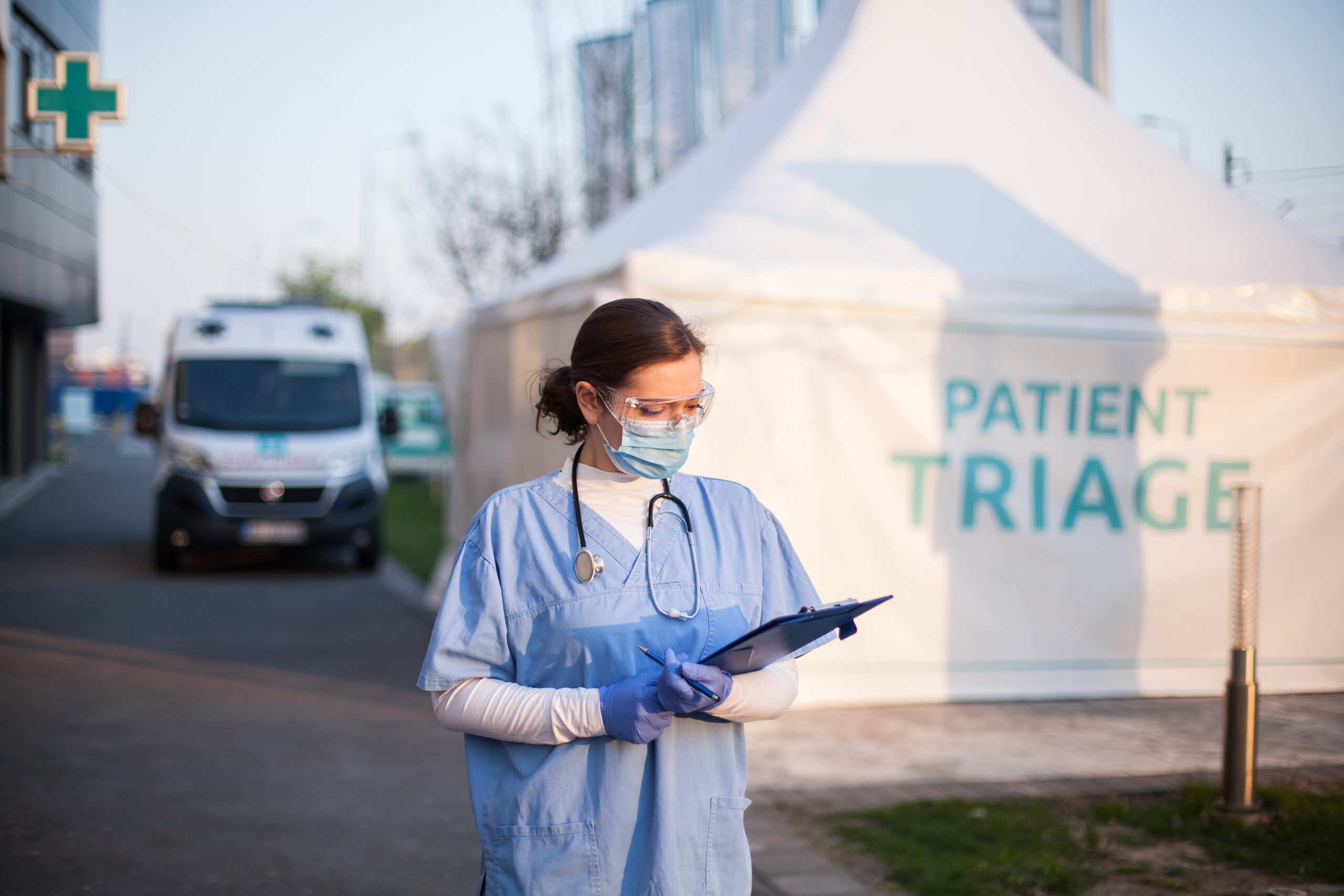
Beyond Comfort: Why Healthcare Triage and Surge Capacity Require Medical-Grade Air
TL;DR
- Medical-grade air for temporary healthcare is a clinical necessity that requires strict adherence to ANSI/ASHRAE/ASHE Standard 170, extending far beyond basic temperature control.
- True surge capacity demands a minimum of 12 air changes per hour (ACH) and verified negative pressure to maintain airborne infection isolation (AII) protocols.
- Off-the-shelf, consumer-grade portable HVAC units fail in medical settings because they lack true HEPA filtration, fail to sustain pressure differentials, and break down under 24/7 continuous use.
- TEMP-AIR® Equipment Sales operates as a “Specialist Engine”, providing hospital facility managers with ruggedized, compliant climate systems and 24/7 engineering support to reduce administrative burdens and guarantee patient safety.
When patient volumes spike due to pandemics, natural disasters, or mass casualty events, temporary triage tents and alternate care sites (ACS) become vital lifelines. However, erecting a membrane structure in a parking lot is only the first step. The real engineering challenge is ensuring the interior environment is clinically safe and compliant. We are discussing medical-grade air for temporary healthcare.
For hospital facility managers, emergency response coordinators, and healthcare engineers, the priority is always risk avoidance and patient safety over upfront cost savings. In these mission-critical environments, standard air conditioning simply does not suffice.
What is the “Surge” Reality in Healthcare Facilities?
The “surge” reality in healthcare facilities is the sudden transition from standard operations to an unplanned, temporary increase in medical need that exceeds the planned capacity of a building. In these scenarios, the objective of temporary HVAC shifts from “comfort cooling” to “critical continuity,” meaning the air system must actively mitigate the spread of pathogens while stabilizing the environment.
During an emergency surge, hospitals are often forced to establish triage and treatment areas in exterior spaces, such as ambulances bays or temporary tents. In these makeshift environments, a standard portable air conditioner might keep patients physically cool, but it completely ignores the risk of airborne cross-contamination.
True critical continuity treats the air as a vital component of infection prevention. It requires dedicated systems equipped with advanced filtration and precise pressurization controls to safely separate infectious patients from the general population and the medical staff treating them. When deploying an alternate care site, achieving this level of environmental control is the difference between a safe recovery zone and a compromised facility.
What Are the Technical Compliance Standards for Medical-Grade Air in Temporary Structures?
The technical compliance standards for medical-grade air in temporary structures are dictated largely by ANSI/ASHRAE/ASHE Standard 170. This standard requires Airborne Infection Isolation (AII) environments to maintain 12 air changes per hour (ACH) and a minimum negative pressure differential of minus 0.01″ w.c.. Furthermore, any exhausted or recirculated air must pass through stringent high-efficiency filtration.
Deploying a temporary triage structure without meeting these baseline engineering benchmarks puts both healthcare workers and vulnerable patients at severe risk. High-efficiency particulate air (HEPA) filters are the cornerstone of medical-grade air. By definition, a true HEPA filter captures at least 99.97% of airborne particles that are 0.3 microns in size, which is the most penetrating and difficult particle size to trap. Because of how particles behave at a microscopic level, HEPA filters are actually even more efficient at capturing smaller viral particles (around 0.1 microns) through mechanisms like diffusion and interception.
During a crisis, guidelines from the Centers for Disease Control and Prevention (CDC) and the Facility Guidelines Institute (FGI) emphasize that portable HEPA filtration machines can be utilized to rapidly increase ACH or establish expedient negative pressure rooms when traditional, hardwired AII rooms are at capacity. For temporary membrane structures and tents, creating these pressure differentials and achieving proper air dilution via mechanical ventilation is not a luxury—it is a strict medical mandate.
Why Do “Off-the-Shelf” Solutions Fail in Medical Environments?
“Off-the-shelf” HVAC solutions fail in medical environments because they lack verified HEPA filtration, cannot sustain required air pressure differentials, and are built with consumer-grade materials that cannot survive 24/7 continuous operation. In a disaster recovery zone, these units inevitably break down, creating severe safety risks and operational downtime.
Facility managers must avoid the “cheap trap.” A commercial spot cooler sourced from a big-box store might save a few hundred dollars upfront, but if it lacks a heavy-duty steel cabinet or industrial-grade casters, it will be destroyed within a few rental cycles in a high-traffic triage environment.
Beyond physical durability, standard units lack the sophisticated filtration required for infectious control. Medical-grade systems, such as the Abatement Technologies PAS2400 or the Airrex HEPA-2000, utilize a rigorous multi-stage filtration process. They rely on pre-filters to capture larger debris (like lint and dust), which protects and extends the life of the primary HEPA filter responsible for trapping pathogens. When relying on consumer units, hospitals risk mechanical failure and rapid filter clogging, which halts critical airflow and instantly compromises negative pressure zones.
What is the TEMP-AIR® Equipment Sales Advantage for Healthcare Engineers?
The TEMP-AIR® Equipment Sales advantage lies in our role as a “Specialist Engine” for healthcare facilities, providing ruggedized, compliant portable HVAC systems backed by 24/7 engineering support. This turnkey approach drastically reduces the administrative and operational burden on hospital staff, allowing clinical teams to focus entirely on patient care rather than infrastructure troubleshooting.
We understand that for healthcare engineers, the ultimate metric of success is risk avoidance. TEMP-AIR® equipment is explicitly engineered for “high-touch,” mission-critical environments. Our fleet includes specialized assets like low-grain refrigerant (LGR) dehumidifiers to prevent mold in water-damaged sites, and advanced HEPA air scrubbers designed to seamlessly interface with mobile dust containment carts for negative air environments.
When a patient surge hits, you do not just need a piece of equipment dropped at a loading dock. You require a partner who understands the technical nuances of ASHRAE compliance, BTU load calculations, and negative pressure isolation. With TEMP-AIR® Equipment Sales, you gain access to an inventory of professional-grade assets and the 24/7 technical expertise required to deploy them flawlessly in the field.
Technical Checklist for Facility Managers: Assessing Medical-Grade Air Solutions
Before deploying temporary HVAC in an alternate care site, verify that your equipment and partner can meet the following criteria:
- Filtration Integrity: Does the unit feature a certified HEPA filter capable of capturing 99.97% of 0.3-micron particles, protected by adequate pre-filters?
- Ventilation Capacity: Can the system reliably achieve and sustain the ASHRAE-mandated 12 ACH required for infectious isolation?
- Pressurization Control: Does the equipment support the creation of a negative pressure environment (minimum -0.01″ w.c.) with appropriate, safe exhaust routing?
- Industrial Durability: Is the unit constructed with heavy-duty steel and industrial components to withstand 24/7 operation in harsh, temporary, or outdoor environments?
- Operational Support: Is the equipment backed by 24/7 engineering and technical support to handle mid-crisis troubleshooting and turnkey setup?
Secure Your Mission-Critical Infrastructure with TEMP-AIR® Equipment Sales
Do not leave your facility’s surge capacity to chance. Protect your patients, safeguard your staff, and maintain your compliance standing with engineered climate solutions.
Contact TEMP-AIR® Equipment Sales today at 1-888-535-8841 or visit our website to speak with our technical specialists about equipping your healthcare facility with robust, medical-grade air solutions.
Frequently Asked Questions (FAQs)
Question: What is medical-grade air for temporary healthcare?
Answer: Medical-grade air for temporary healthcare refers to specialized portable HVAC and filtration systems deployed in alternate care sites that meet strict clinical standards, such as ASHRAE 170. These systems utilize verified HEPA filtration, achieve high air changes per hour (ACH), and possess the mechanical capability to maintain negative pressure environments to prevent cross-contamination.
Question: How do portable HEPA scrubbers assist in surge capacity?
Answer: Portable HEPA scrubbers assist in surge capacity by filtering out 99.97% of airborne pathogens and allowing facility managers to quickly convert standard rooms, or temporary triage tents, into negative pressure isolation zones. This safely mitigates the transmission of infectious aerosols when traditional, hardwired hospital isolation rooms are full.
Question: Why should hospitals avoid consumer-grade portable AC units for triage?
Answer: Hospitals should avoid consumer-grade portable AC units because they lack the necessary HEPA filtration to handle bio-aerosols, cannot reliably sustain required air pressure differentials, and are highly prone to mechanical failure under the stress of continuous 24/7 use in harsh, temporary environments.