
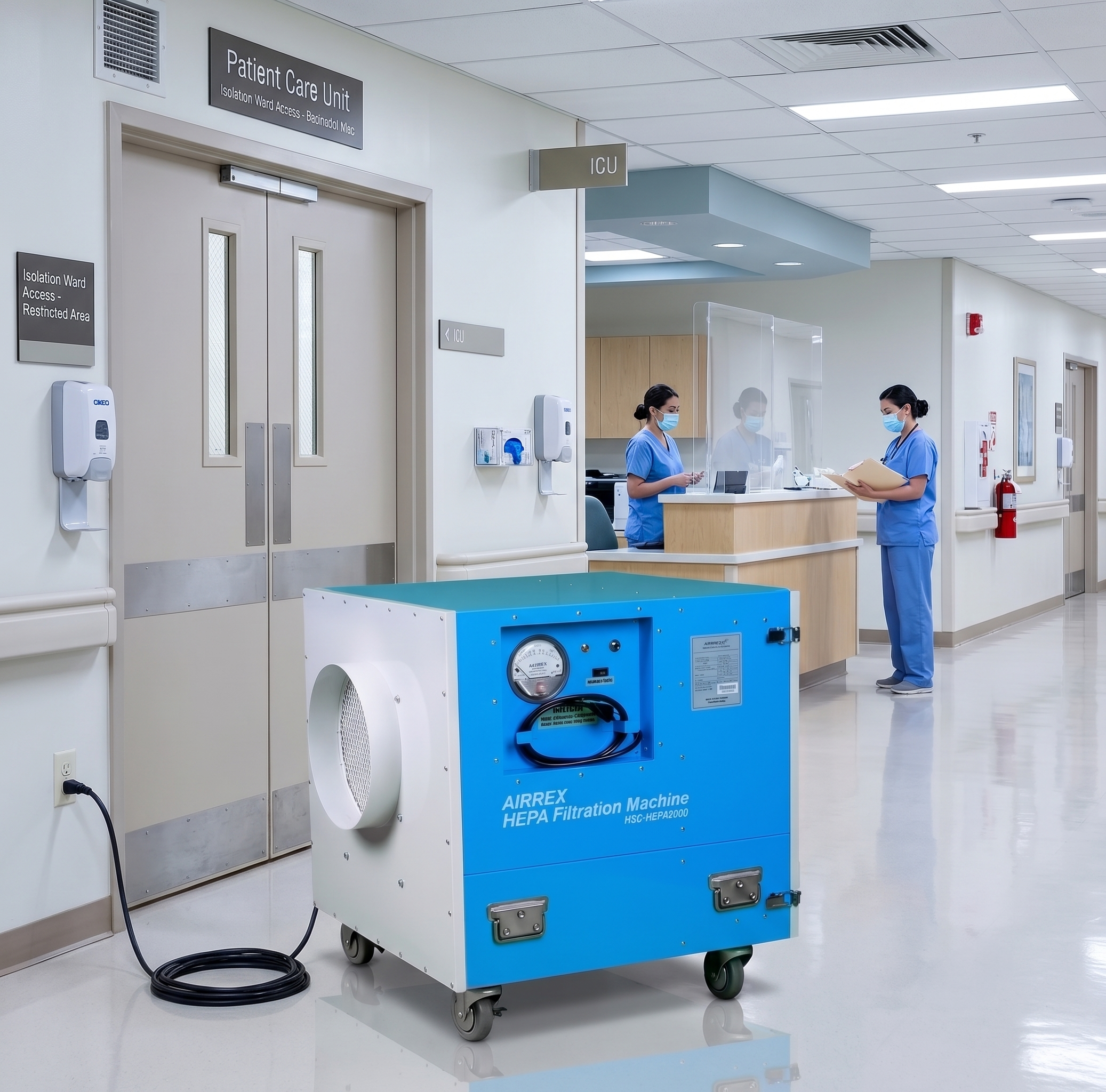
Portable Air Scrubbers: How to Eliminate Hidden Airborne Liabilities in Medical Facilities
TL;DR: The Quick Summary for Healthcare Administrators
- Medical-grade air scrubbers drastically reduce healthcare-associated infections (HAIs) by capturing 99.97% of airborne pathogens and contaminants.
- Deploying HEPA-filtered air scrubbers ensures compliance with rigorous ICRA (Infection Control Risk Assessment) standards during facility renovations and construction.
- Strategic air scrubbing mitigates operational risks by continuously sanitizing the air in high-traffic zones like waiting rooms, emergency departments, and operating rooms.
In modern healthcare, poor indoor air quality is a silent liability that threatens both patient safety and your facility’s bottom line. Airborne pathogens, infectious aerosols, and fine construction dust can circulate undetected, leading to a rise in healthcare-associated infections (HAIs) and severe compliance violations. If your hospital relies solely on traditional HVAC systems during high-risk scenarios, you are leaving your most vulnerable occupants exposed.
What are commercial air scrubbers and how do they work in hospitals?
A commercial air scrubber is a heavy-duty, portable filtration system designed to draw in contaminated air, scrub it through multi-stage HEPA filters, and exhaust clean air back into the medical environment. This process continuously purifies the air and controls infection risks.
Unlike standard residential air purifiers, true medical-grade air scrubbers are robust machines engineered for rapid, continuous air filtration within defined clinical spaces. The purification journey involves a sophisticated multi-stage process. First, air is pulled through pre-filters that capture larger particles like dust and hair, effectively protecting the lifespan of the primary filter. Next, the air moves through a certified HEPA (High-Efficiency Particulate Air) filter, which is the critical core of the system. These HEPA filters are tested to capture 99.97% of airborne particles down to 0.3 microns, successfully trapping bacteria, mold spores, and virus-carrying droplet nuclei. Additionally, many units integrate activated carbon filters to absorb volatile organic compounds (VOCs) and neutralize medical odors, ensuring a comprehensively sanitized healing environment.
Why are commercial air scrubbers required during medical facility renovations?
Air scrubbers are mandatory during hospital construction to capture hazardous dust and dormant pathogens, such as Aspergillus mold, preventing them from escaping the containment zone. They are essential for meeting strict Infection Control Risk Assessment (ICRA) compliance.
Any renovation or maintenance activity within an active hospital presents a high-risk event that can severely compromise indoor air quality. Construction dust often carries dangerous silica and dormant microbial threats that can easily travel through HVAC networks if not properly contained. According to the latest ICRA 2.0 standards from ASHE, hospitals must deploy stringent containment protocols based on the project type and patient risk group. Utilizing an industrial air scrubber, often in conjunction with negative air machines, creates a negative-pressure environment that isolates contaminants and protects immunocompromised patients. By continuously filtering the air and exhausting it safely, these units prevent dangerous particles from breaching physical barriers, keeping your facility compliant and your patients safe.
How do air scrubbers prevent airborne cross-contamination in medical offices?
Air scrubbers prevent cross-contamination by actively removing infectious aerosols and pathogens from the breathing zone before they spread. They provide a crucial layer of infection control in high-traffic, critical care areas.
Airborne pathogens are recognized as a primary vector for healthcare-associated infections (HAIs). In densely occupied areas like patient waiting rooms, emergency departments, and doctors’ offices, the risk of transmission is significantly elevated. Deploying portable HEPA air scrubbers in these spaces captures dangerous microbes directly from the air, effectively breaking the chain of infection. For instance, while negative air machines maintain containment in specific isolation rooms, placing air scrubbers in common hallways or nurses’ stations acts as an essential secondary defense, catching any stray contaminants that might escape. Furthermore, aligning with ASHRAE Standard 170 guidelines for healthcare ventilation, the strategic use of portable HEPA filtration provides necessary air changes per hour (ACH) to dilute and remove infectious agents, safeguarding both frontline staff and vulnerable patients.
TEMP-AIR® Equipment Sales Featured Units: High-Efficiency Air Scrubbers
- Airrex by TEMP-AIR® Equipment Sales HEPA-2000P Portable Air Scrubber
- Airflow Capacity: 2,000 CFM (Cubic Feet per Minute)
- Filtration: True HEPA filtration designed for large-scale dust, mold, and airborne contaminant pull.
- Best For: Heavy-duty commercial restoration, construction sites, and large industrial spaces requiring high-volume air turnover.
- PAS2400 Portable Air Scrubber
- Airflow Capacity: 2,100 CFM
- Filtration: High-efficiency HEPA filtration capable of capturing microscopic particulates.
- Best For: Large-scale abatement, negative pressure air setups, and rigorous construction or remediation projects demanding maximum airflow.
- PAS750 Portable Air Scrubber
- Airflow Capacity: 750 CFM
- Filtration: Professional-grade HEPA filtration in a more compact footprint.
- Best For: Small to medium-sized remediation zones, hospital renovation areas, or targeted mold/dust containment where space is limited but commercial power is still required.
Ready to optimize your facility’s air quality?
Protecting your patients and maintaining strict medical compliance shouldn’t be complicated. Partner with TEMP-AIR® Equipment Sales today for advanced commercial air scrubbing solutions.
- Call us at 1-888-535-8841
- Or Click Here to contact the experts at TEMP-AIR® Equipment Sales
Commercial Air Scrubbers: Medical Facility FAQs
Question: How often do HEPA filters need to be replaced in medical air scrubbers?
Answer: A commercial HEPA filter can last up to one year, but its lifespan heavily depends on the environment and usage frequency. Pre-filters and carbon filters should be replaced monthly to prevent restricted airflow and extend the primary HEPA filter’s life.
Question: What is the difference between a negative air machine and an air scrubber?
Answer: While both utilize HEPA filtration, an air scrubber cleans and recirculates air within the same room. A negative air machine filters the air and exhausts it completely outside of the containment zone via ducting, creating a negative pressure environment that prevents contaminants from escaping.
Question: Are commercial air scrubbers FDA-approved?
Answer: The air scrubber equipment itself is not FDA-approved, but the HEPA filters inside them are rigorously certified to meet strict performance standards. True HEPA filters are proven to capture 99.97% of particles at 0.3 microns, complying with medical and industrial safety requirements.
Question: Where should portable air scrubbers be deployed in a hospital?
Answer: They are most effective in high-traffic and high-risk zones, including emergency rooms, patient waiting areas, operating rooms, and doctors’ offices. They are also critical inside construction containment zones during facility renovations to control hazardous dust.