
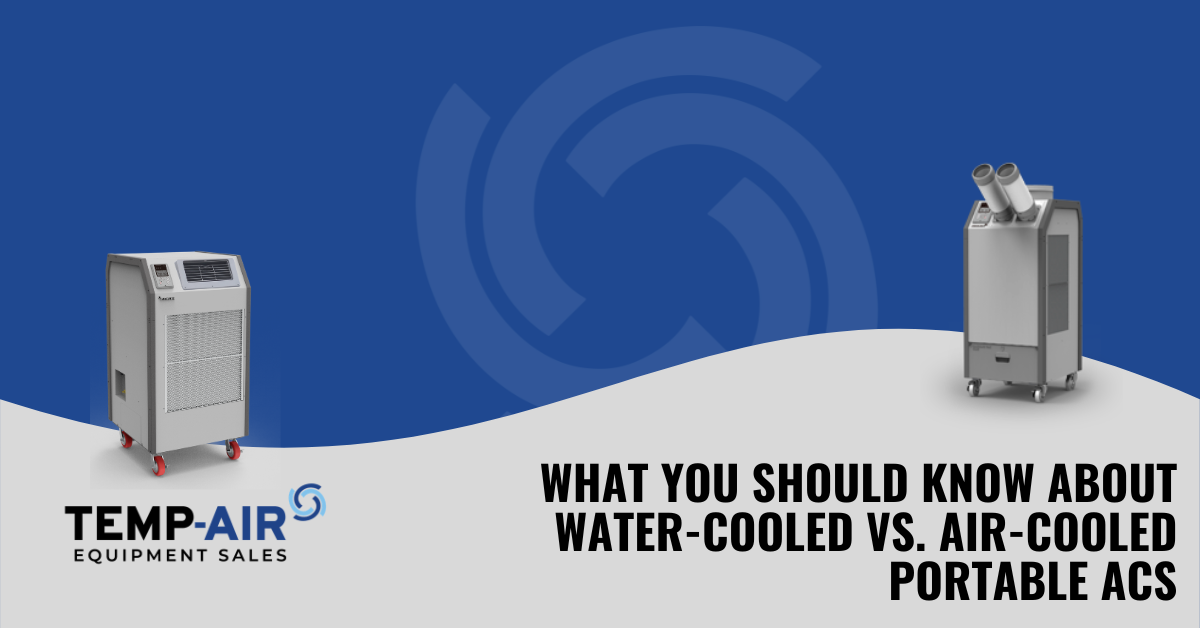
What You Should Know About Water-Cooled vs. Air-Cooled Portable ACs
TL;DR: Key Takeaways
- Water-cooled portable ACs use water, not ambient air, to remove heat. This makes them highly efficient in extreme temperatures where traditional air-cooled units struggle.
- They are functionally “ventless.” Heat escapes down a drain via wastewater, eliminating the need for bulky 6-inch air exhaust hoses, drop ceilings, or window vents.
- Energy efficiency is superior in high-heat zones. Water is a better heat conductor than air, allowing the compressor to operate with less electrical strain, ultimately lowering power consumption.
- Ideal for enclosed, critical environments. These units shine in data centers, laboratories, and retail spaces with limited external ventilation.
Warning! Are you wasting money and energy cooling your industrial space with the wrong equipment? When an HVAC system fails or a server room begins to overheat, facility managers often rush to rent the first portable air conditioner they can find. However, in high-heat, enclosed environments, traditional air-cooled spot coolers can actually make your problems worse. Understanding the fundamental differences between water-cooled and air-cooled climate control solutions is the secret to maintaining operational efficiency, protecting expensive equipment, and keeping your energy bills in check.
How Does a Water-Cooled Air Conditioner Work?
A water-cooled air conditioner works by removing heat from a compressed refrigerant vapor and transferring it directly into a continuous flow of water. Instead of relying on a fan to blow hot air into a ceiling or out a window, the water absorbs the heat and safely carries it away down a standard drain.
To understand this, we have to look inside the condenser. The core of a water-cooled unit is essentially a highly efficient heat exchanger. In commercial units, this is typically designed as a coaxial (tube-in-tube) system, or a shell-and-tube configuration. Hot, high-pressure refrigerant gas enters the inner condenser coils. Simultaneously, cool water from a connected supply line (like a utility sink or a dedicated cooling tower) flows through the outer casing, passing over the hot refrigerant tubes.
Because water is a vastly superior thermal conductor compared to ambient air, it rapidly absorbs the heat energy from the gas. As the heat is extracted, the refrigerant cools and condenses back into a liquid, ready to cycle through the evaporator to create cold air for your room. The water, now warm from absorbing the heat, is discharged out of the building through a drain or wastewater outlet. This simple but incredibly effective thermodynamic exchange allows the unit to produce frigid air without generating a massive footprint of waste heat.
Why Choose a Ventless “No Exhaust” Water-Cooled Unit?
You should choose a water-cooled unit because it is completely self-contained and does not require ducting or large exhaust hoses to vent hot air out of your building.
Traditional air-cooled portable ACs capture heat from your room and use a fan to blow that hot air outside. To prevent that hot air from simply recirculating back into your workspace, you must attach a large, flexible vent hose (usually 6 inches or larger) and route it into a drop ceiling, out a window, or through an exterior wall.
In many modern retail spaces, listed properties, or secure underground server rooms, drop ceilings and windows simply do not exist. Pumping hot air into an unventilated drop ceiling can also cause severe heat buildup, damaging wires and offsetting the cooling effect you just paid for. Water-cooled units solve this logistical nightmare. Because the waste heat is entirely trapped within the exit water, there is no hot exhaust air. They are the ultimate “ventless” portable cooling solution for tight, enclosed spaces.
What is the Efficiency Gap Between Air-Cooled and Water-Cooled ACs?
Water-cooled ACs are inherently more energy-efficient than air-cooled units because they rely on the stable, cool temperature of incoming water rather than the fluctuating, often extreme temperatures of ambient indoor air.
Let’s look at the science of the efficiency gap. An air-cooled condenser relies on the air in the room (or the air outdoors) to cool its hot refrigerant. If you place an air-cooled unit in a bakery, a glass-walled office in July, or a server room that is already pushing 95°F, the unit has to work incredibly hard to “dump” heat into air that is already hot. As ambient temperatures rise, an air-cooled unit loses its cooling capacity and draws significantly more electrical amperage.
A water-cooled system completely bypasses the ambient air bottleneck. Because it uses a continuous flow of water—which generally remains at a stable, cool temperature straight from the municipal line—the compressor never has to struggle against the room’s heat. This allows water-cooled systems to maintain a consistent temperature drop and operate safely in extreme environments up to 105°F. Consequently, water-cooled spot coolers consume less electrical power, run less frequently, and suffer less mechanical wear and tear over time.
Where Are Water-Cooled Portable ACs Best Utilized?
Water-cooled portable ACs are best utilized in sealed, high-heat environments that lack exhaust ventilation, such as IT server rooms, commercial bakeries, medical manufacturing labs, and retail spaces without drop ceilings.
Because they do not discharge warm air back into their surroundings, they provide exceptional, targeted “spot cooling”. Here are a few scenarios where they outperform traditional HVAC and air-cooled units:
- Mission-Critical Data Centers: Server rooms generate massive, concentrated heat loads. A water-cooled unit can be wheeled directly next to an overheating server rack to provide pinpoint cooling without altering the room’s overarching HVAC layout.
- Listed Buildings and Historic Properties: Properties with strict conservation rules prohibit the installation of external condensers or window vents. Water-cooled units preserve the building’s aesthetic by running entirely indoors off existing plumbing.
- Emergency HVAC Failures: When a building’s central chiller or cooling tower goes down, you need instant relief. A water-cooled spot cooler can be rapidly deployed to keep operations running smoothly while repairs are made, provided a sink and drain are nearby.
Which One is Right for You?
Choosing the right portable climate solution ultimately comes down to your building’s infrastructure and your specific operational constraints. If you need a highly mobile, “plug and play” unit to move around a warehouse or an office that has accessible drop ceilings, an air-cooled spot cooler is an excellent, straightforward choice. It requires fewer resource hookups and gets the job done reliably.
However, if you are tasked with cooling a windowless retail shop, an enclosed IT closet, or a space where running ductwork is impossible, the water-cooled portable AC is your best option. By tapping into your building’s existing plumbing and investing in advanced, regulation-compliant models like the Airrex by TEMP-AIR® Equipment Sales HWC-19R or Airrex by TEMP-AIR® Equipment Sales HWC-60R, you gain access to a remarkably efficient, quiet, and powerful cooling machine that won’t compromise your indoor air boundaries.
Is a water-cooled unit right for your space?
Our climate control experts are ready to help you evaluate your building’s infrastructure and select the most efficient system for your needs.
- Call TEMP-AIR® Equipment Sales today at 1-888-535-8841
- Visit our website to explore our full range of portable cooling solutions.
Frequently Asked Questions (FAQs)
- Question: Do water-cooled portable ACs need a drain?
- Answer: Yes, they require a continuous water source (like a utility sink or a dedicated water line) and a nearby drain to safely expel the heated wastewater generated during the cooling process.
- Question: Are water-cooled ACs more expensive to run?
- Answer: It depends on your utility rates. While water-cooled units consume significantly less electrical power than air-cooled units, they do require a constant flow of water. A 1-ton unit can use up to 3 gallons of water per minute, which will increase your water bill.
- Question: How far can the water source be from the portable AC unit?
- Answer: Water-cooled units are surprisingly flexible. Depending on the water pressure of your building, the faucet or supply line can sometimes be located over 100 feet away from the unit, utilizing industrial hoses to bridge the gap.
- Question: Can a portable AC replace my central air conditioning system?
- Answer: No. Portable ACs and spot coolers are designed to supplement your central HVAC system, not replace it. They are best used to offset the workload of a central unit by spot-cooling specific, high-heat areas (like a server room) rather than attempting to cool an entire building.